
Rotating mobile proxies relay internet requests through cellular connections and change the outward-facing IP address under configured rules. Documentation from Oxylabs describes mobile proxy access and session controls separately. That distinction matters: cellular connectivity supplies the network address, while proxy software decides how requests use it.
Mobile IP pools are packaged as access to shared networks or individually assigned proxies. The page titled Affordable 4G Rotating Proxies Mobile IP Ranges illustrates how commercial descriptions combine network generation, rotation, and pricing. Treat these as separate specifications. Developers and testing teams should check the underlying connection, available locations, session rules, and access controls before choosing a setup.
1. SIM-Based Connectivity Supplies the Cellular Link
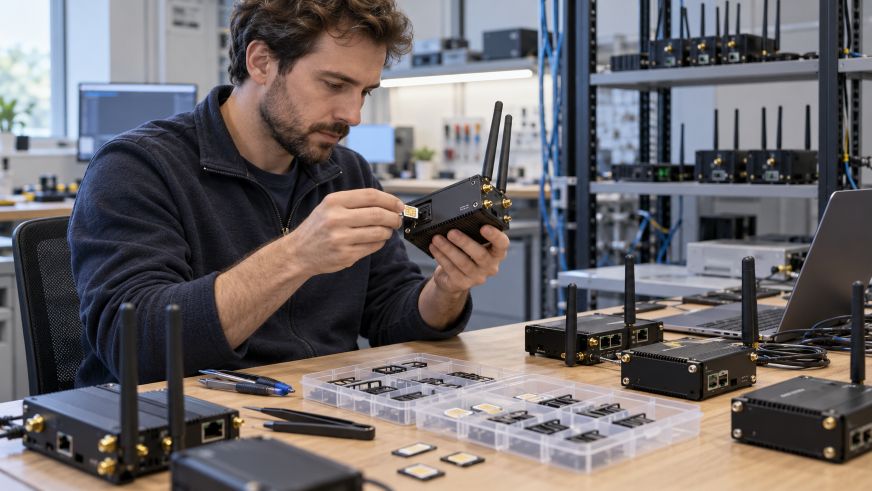
A mobile proxy needs a cellular connection somewhere in its delivery path. Proxidize, for example, documents a managed network using physical 4G and 5G SIM cards. This provides an example of SIM-backed infrastructure, rather than treating every mobile proxy offering as technically identical.
The subscription and the proxy account perform different jobs. Research by Joe-Kai Tsay and Stig Mjølsnes examines LTE Authentication and Key Agreement, the cellular authentication process. Proxy credentials, discussed below, govern access to the relay service instead.
For evaluation, ask how cellular connections are supplied and maintained. A useful specification should identify the connection model and supported carriers. Avoid assuming that a large advertised address pool means an equally large number of dedicated devices available simultaneously.
2. Carrier Networks Determine Address Sharing
Carrier infrastructure sits between the cellular connection and the public internet. The Internet Engineering Task Force explains in RFC 6598 how shared address space supports carrier-grade network address translation, commonly called CGNAT. Translation allows providers to manage limited public IPv4 resources.
This creates an important distinction between an internal network address and the public address a destination sees. The shared range defined in RFC 6598 is not globally routable. It is intended for use within service-provider networks.
When reviewing mobile IP ranges, therefore, ask about public exit addresses rather than simply counting SIMs or internal addresses. Also ask whether access is shared. These questions help clarify what the purchased resource actually represents and how exclusivity is defined.
3. Rotation Controls Change the Exit Address
Rotation is a control function layered onto the connection. Proxidize documents individually assigned proxies with manual rotation, schedules, and rotation URLs. Its pooled offering instead provides access to a mobile network through designated access points.
These models give users different kinds of control. A scheduled change specifies when rotation is requested. Pool access describes how traffic reaches available exits. Neither description alone tells you how many distinct public addresses your workload will receive.
For independent regional checks, evaluate the observed address changes across a representative sample. Record repeated exits and interruptions as well as successful changes. When assessing a plan billed by traffic volume, consider mobile data usage alongside rotation settings. This gives you a clearer basis for evaluating the service than its advertised pool size alone.
4. Session Management Provides Temporary Continuity
Some workflows need several requests to retain one address. Oxylabs documents session identifiers that route multiple requests through the same exit while it remains available. Its documentation also describes time limits, inactivity expiry, and reassignment when an exit goes offline.
A sticky session therefore needs a defined failure policy. In one documented mode, an unavailable exit triggers reassignment. In another, the request fails rather than switching addresses. These are different behaviors, even though both use session controls.
For a multi-page application test, decide whether continuity or automatic recovery matters more. Check the inactivity limit against expected pauses. Keep each test’s session identifier consistent, and define what the application should do when continuity ends.
5. Geographic Routing Selects Suitable Exits
Geographic routing filters exits by location or network attributes. Oxylabs lists country, state, city, coordinate, and autonomous system number targeting for its mobile service. Those controls describe that provider’s implementation, rather than a universal feature set.
Location labels require interpretation. MaxMind explains that mobile-network geolocation can resolve to a broad region instead of a specific city or postal code. A requested city should therefore be checked against the location information used by the application being tested.
6. Proxy Authentication Controls Service Access
Proxy authentication determines who can use the gateway. Oxylabs demonstrates username-and-password access and documents IP allowlisting for certain entry points. Keep these access rules separate from carrier authentication and geographic targeting.
Authentication also needs appropriate transport protection. The Internet Engineering Task Force warns in RFC 7617 that HTTP Basic credentials are effectively exposed without an external secure mechanism such as TLS. Encoding credentials does not encrypt them.
Match the Technology to the Application
Evaluate rotating cellular proxies through measured response times, exit availability, address changes, session continuity, location accuracy, and secure access. For regional testing or multi-step checks, prioritize the controls your workflow requires. A clear specification and representative trial provide a practical foundation for judging performance, reliability, and suitability.